


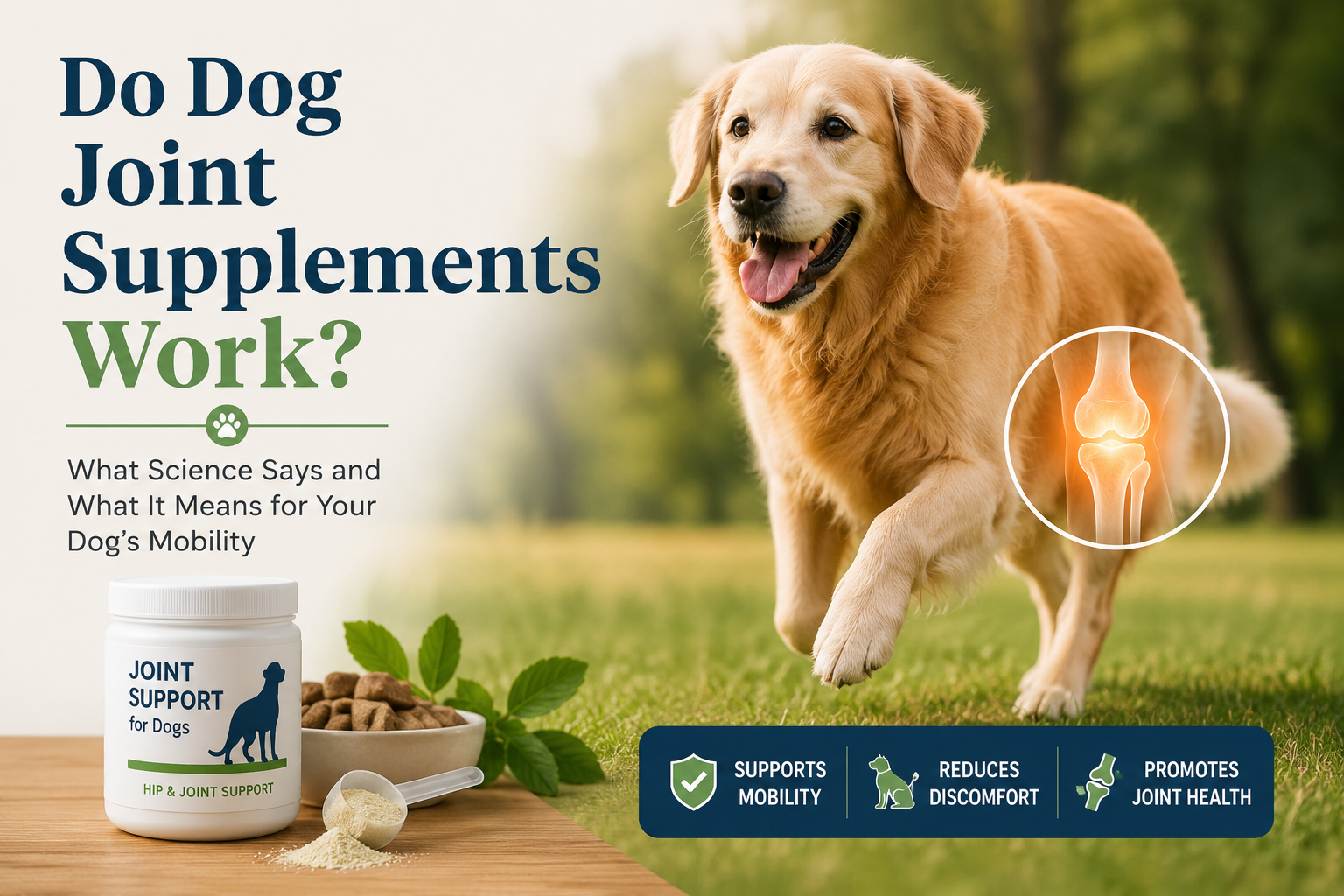
The honest answer is: it depends on which ingredient you are asking about. The evidence ranges from genuinely strong to nearly nonexistent. This article goes through each major supplement, what the actual research says, and what vets currently recommend.
What the Research Shows in Plain Terms
- Omega-3 fatty acids (fish oil / EPA and DHA): strongest evidence, AAHA first-line recommendation
- UC-II collagen: outperforms glucosamine in head-to-head studies, emerging favourite
- Glucosamine and chondroitin: mixed evidence, slow-acting, still widely used by vets
- Green-lipped mussel: promising early results, needs more clinical trials
- MSM: anti-inflammatory, often paired with glucosamine, limited standalone trials
- Boswellia serrata: herbal anti-inflammatory, small but positive trials in dogs
How Common Is Joint Disease in Dogs?
Before evaluating supplements, it helps to understand just how widespread this problem is.
Osteoarthritis is not just a condition for very old dogs. Research published in Scientific Reports in 2024 found that 39.8% of dogs aged 8 months to 4 years already had radiographic signs of arthritis in at least one joint. Most of their owners had no idea.
In dogs over 7, the numbers are stark. Studies estimate that up to 80% of dogs in this age group are affected by osteoarthritis to some degree. Yet fewer than half of those dogs show obvious lameness. The rest appear normal to their owners while quietly compensating for pain with every step they take.
Because arthritis is so prevalent and so often silent, many owners start supplements reactively, after significant joint damage has already occurred. The evidence suggests supplements work best as early interventions that slow progression, not as treatments for advanced disease. Starting your senior dog on a well-evidenced supplement at 7 or 8 is more likely to help than starting at 12.
What the Research Actually Shows
The real evidence base , not what the packaging claims
Many supplement studies are funded by manufacturers. Independent reviews consistently find weaker effects than industry-funded trials. When you see a supplement brand citing “clinically proven” results, always check who funded the study. This does not mean the ingredient does not work. It means the evidence requires more scrutiny than the label suggests.
Each Ingredient Reviewed One by One
Here is an honest assessment of every major dog joint supplement ingredient, based on current peer-reviewed evidence.
Omega-3 Fatty Acids (EPA and DHA)
Omega-3 fatty acids are the most evidence-backed joint supplement available for dogs. EPA and DHA work by competing with inflammatory compounds in the body, reducing the chemical signals that cause joint inflammation and pain. Multiple randomised controlled trials show measurable improvement in mobility.
The AAHA lists omega-3 as a first-line option for canine osteoarthritis. Force plate studies, which measure how much weight a dog places on a painful limb, show dogs on therapeutic omega-3 doses load significantly more weight on arthritic joints than dogs not supplemented.
What to buy: Look for products stating EPA and DHA amounts specifically, not just “fish oil” in general. The omega-3 content in unlabelled fish oil varies enormously. Products should be in dark bottles to prevent oxidation. See our joint mobility home guide for other ways to support arthritic dogs.
UC-II Undenatured Type II Collagen
UC-II collagen works through a completely different mechanism than glucosamine. Instead of trying to rebuild cartilage directly, it works via immune tolerance. Small amounts of the collagen are absorbed in the gut, where the immune system learns to stop attacking the cartilage in the joints.
In a head-to-head trial, UC-II outperformed glucosamine and chondroitin combined on pain scores, limb function, and overall mobility. The 2022 Varney study showed it prevented increases in inflammatory and cartilage-degrading biomarkers in Labrador Retrievers. It is the ingredient many veterinary specialists are now most interested in.
Glucosamine and Chondroitin
Glucosamine and chondroitin have been used in dogs for decades. They are building blocks of cartilage and joint fluid. The theory is sound: giving the joints more raw materials should help them maintain and repair cartilage tissue. The research, however, is more complicated than the marketing.
The 2021 systematic review found that 8 out of 9 controlled studies showed no analgesic effect. The 2007 double-blind positive-controlled trial found meaningful benefit. Vets who use them successfully recommend pairing them with NSAIDs for the first two to three months, then gradually reducing the NSAID as the supplement builds up. The key phrase from DVM360 is that “onset of action is slow” , most studies that found no effect ran for too short a duration.
Green-Lipped Mussel
Green-lipped mussel is interesting because it contains a combination of omega-3 fatty acids, glycosaminoglycans, and other compounds that are not found in standard fish oil. Early trials show meaningful pain reduction in arthritic dogs. The Journal of Small Animal Practice review described the results as “promising.”
The limitation is the evidence base is still small. Hielm-Bjorkman et al. found significant improvements in quality of life scores and force plate measurements compared to placebo. That is a solid trial. But more independent replications are needed before this moves into the same category as omega-3.
MSM (Methylsulfonylmethane)
MSM is a natural sulfur compound that appears in many glucosamine formulations. It has anti-inflammatory properties and may support cartilage health. Most of the evidence for MSM in joint disease comes from human studies, with limited independent canine-specific trials.
It is likely helpful as part of a combination supplement. As a standalone treatment the evidence is too thin to make a strong recommendation. It appears safe at standard doses and may add some benefit to a supplement stack that already includes better-evidenced ingredients.
Boswellia Serrata
Boswellia serrata is a tree resin extract used in Ayurvedic medicine. It inhibits 5-lipoxygenase, an enzyme involved in the inflammatory process. In dogs, small studies have shown reduced lameness and improved mobility scores compared to placebo.
The trials are encouraging but small. Boswellia is commonly found in veterinary-formulated supplements as part of a multi-ingredient approach. It is a reasonable addition to a supplement protocol that already includes omega-3. It should not be the only ingredient you rely on.
Quick Comparison: All Major Ingredients
| Ingredient | Evidence Level | Primary Action | AAHA Recommended | Best For |
|---|---|---|---|---|
| Omega-3 (EPA and DHA) | Strong | Reduces inflammation | ✅ First-line | All arthritic dogs |
| UC-II Collagen | Emerging strong | Immune tolerance | Not yet rated | Dogs not responding to glucosamine |
| Glucosamine + Chondroitin | Mixed | Cartilage support | Widely used | Early-moderate arthritis |
| Green-Lipped Mussel | Promising | Anti-inflammatory | Not yet rated | Complement to omega-3 |
| Boswellia Serrata | Moderate | Enzyme inhibition | Not yet rated | Multi-ingredient stack |
| MSM | Limited | Sulfur/anti-inflammatory | No | As add-on only |
Why Dose Is the Problem Most Owners Miss
The most common reason a supplement fails is not that the ingredient does not work. It is that the dose is too low to do anything.
Many commercial dog joint supplements contain far less than the amounts studied in clinical trials. A product can legally list glucosamine on the label with only a fraction of the therapeutic dose. Some products rely on the reputation of an ingredient to sell the product, not on delivering a clinically relevant quantity of it.
“The omega-3s in most maintenance diets are not high enough to treat disease states. If an arthritic dog is eating a maintenance diet formulated with omega-3s, the owner will need to administer an omega-3 supplement on top of that to attain therapeutic levels.” This is directly from DVM360’s clinical guidance for vets managing arthritic patients.
How to Choose and What to Avoid
You do not need to buy the most expensive product on the shelf. You do need to buy one that contains the right ingredients at the right doses from a brand that actually tests its products.
Frequently Asked Questions
Omega-3 typically shows results within 4 to 6 weeks. Glucosamine and chondroitin are much slower. Most vets recommend a trial of at least 8 to 12 weeks before judging effectiveness. UC-II collagen falls in between, with some dogs showing improvement in 4 to 8 weeks. Give supplements a full 3-month trial before concluding they are not helping.
Do not use human supplements without checking the ingredients carefully first. Many human joint supplements contain xylitol, which is toxic to dogs. Human products also use different dosing assumptions. Some fish oil products formulated for humans are safe for dogs but you need to calculate the correct dose based on EPA and DHA content, not the capsule size. Always confirm with your vet before using any human product.
This is a growing area of discussion given that 39.8% of dogs under 4 already show radiographic arthritis signs. Omega-3 at a moderate dose is reasonable as a preventive supplement in large and giant breeds known for hip and elbow problems. For smaller breeds with no predisposition to joint disease, the benefit of early supplementation is less clear. Discuss with your vet based on your dog’s breed and size.
High-dose omega-3 can have mild blood-thinning effects and may need monitoring if your dog is already on anti-coagulant medication. Glucosamine and chondroitin are generally considered safe alongside NSAIDs and many vets use them in combination intentionally. Always disclose all supplements to your vet so they can consider interactions with any prescribed medications your dog is taking.
Not always, but the cheapest supplements are often underdosed. The key is to check mg amounts per ingredient rather than using price as a quality indicator. Veterinary brands like Nutramax, VetriScience, and Virbac are well-regarded not because they are expensive but because they publish ingredient amounts transparently and have been studied more than many generic alternatives. Look for NASC seal and published ingredient quantities.
Omega-3 fatty acids are safe and beneficial for cats with arthritis. However, cats are extremely sensitive to certain compounds. Never give a cat glucosamine products formulated for dogs without veterinary guidance. Cats also have different metabolic pathways for handling oils and supplements. Always use feline-specific products or confirm exact doses with your vet for cat use. See our guide on senior cat health problems for more on feline arthritis signs.
The Bottom Line
Dog joint supplements are not a scam. But they are not all equal. The evidence supports some far more than others.
Start with omega-3 fatty acids at a therapeutic dose. Add UC-II collagen if your dog is not responding to omega-3 alone, or if your vet wants to take a more aggressive approach. Consider glucosamine and chondroitin as a long-term supportive measure, understanding that results take months and the evidence is genuinely mixed.
Do not rely on supplements alone. Combine them with weight management, appropriate exercise, non-slip flooring, an orthopedic bed, and regular vet assessments. Arthritis is progressive. The goal is to slow it down, reduce daily pain, and give your dog the best possible quality of life for as long as possible.
And remember: if your dog is already showing obvious signs of pain, supplements are not a substitute for veterinary pain management. They work alongside proper treatment, not instead of it. 🐾



6 thoughts on “Do Dog Joint Supplements Actually Work? What the Science Says (2026)”