
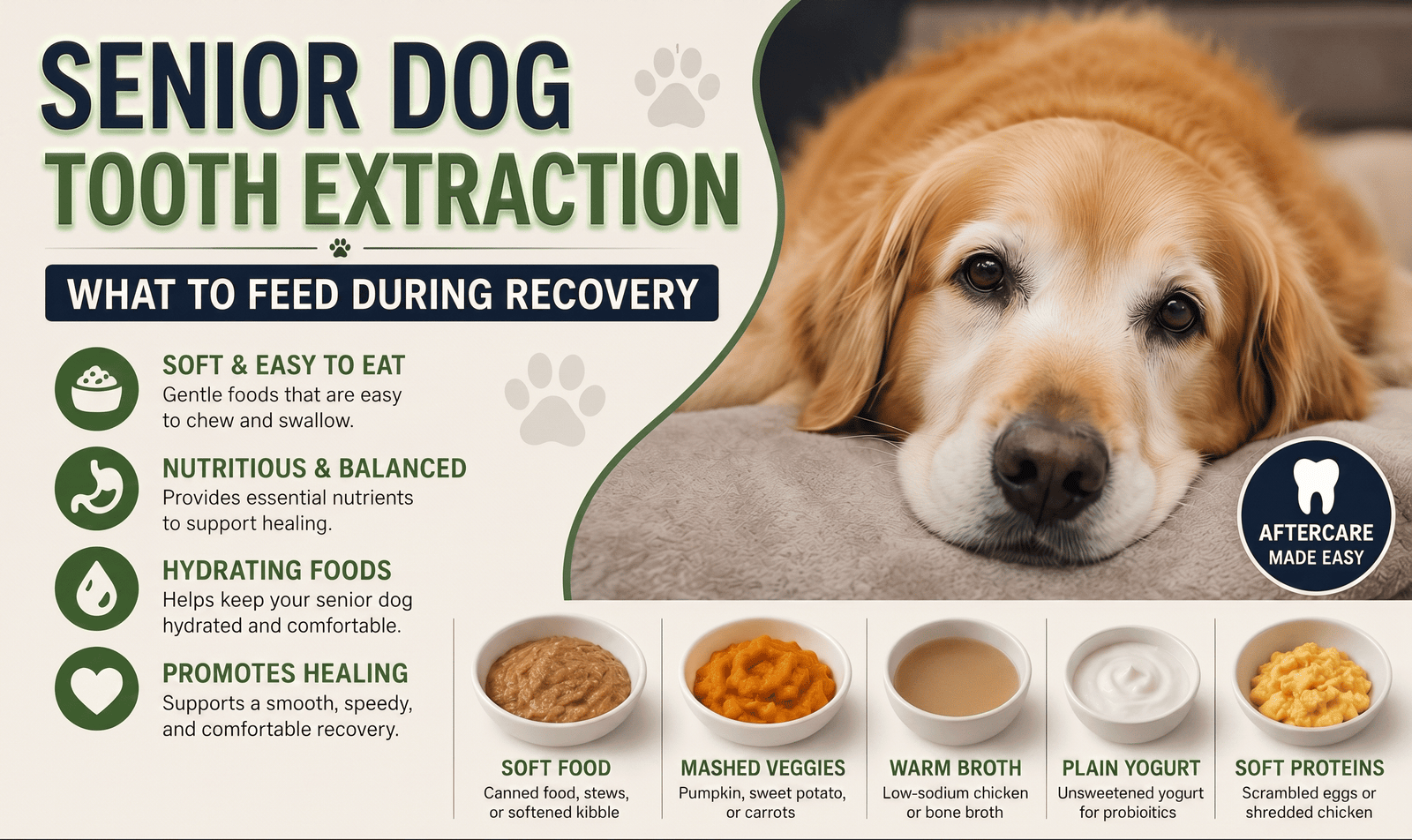
Senior Dog Tooth Extraction Recovery: What to Feed and What to Expect
So now what? What counts as soft food? Can you use his normal wet food? What if he won’t eat at all? And how do you know if something is going wrong?
These are the questions owners actually need answered. This guide goes through the full recovery window, day by day, with specific food options, exact preparation notes, and the warning signs that mean you need to call your vet rather than wait.
What You Need to Know Before Anything Else
- Canned wet dog food at room temperature or slightly warm
- Regular kibble soaked in warm water for 20 minutes until fully mushed
- Plain boiled chicken, shredded very fine, no seasoning at all
- Plain scrambled eggs, no butter, no milk, no salt
- Prescription recovery diet such as Hills a/d or Royal Canin Recovery
- Low-sodium chicken or beef broth poured over any of the above to increase palatability
The First 4 Hours: What to Expect When You Get Home
The drive home from the vet is often the most worrying part for owners. Here is what you will see and what it means.
Your dog will be unsteady. He may stumble getting out of the car. His eyes may look glassy or unfocused. Some dogs shiver even when it is warm. All of this is the anaesthetic leaving his system, not a sign that something went wrong during surgery.
Blood-tinged saliva is normal for the first few hours. The socket bleeds a small amount as the clot forms. What you are watching for is bright red blood that does not slow down or stop , that is different from pink-tinged drool.
Put him somewhere quiet, away from other pets and children. A blanket on a low surface so he doesn’t have to jump is ideal. Senior dogs with arthritis or weak back legs are especially unsteady post-anaesthetic.
Older dogs have reduced liver and kidney function compared to young adults. These organs are responsible for clearing anaesthetic drugs from the bloodstream. A study in the Veterinary Anaesthesia and Analgesia journal found that dogs over 8 years took significantly longer to reach full cognitive recovery post-anaesthesia than younger dogs under the same protocol. This is why your 12-year-old dog may still seem “not quite right” six or even eight hours later. It is not a complication. It is physiology.
Day-by-Day Recovery Guide: What to Feed When
Recovery is not a flat 14 days of identical care. The first 48 hours, days 3 to 7, and the second week each have different priorities and different risks.
Surgery day
Small amounts of soft food only, offered 3 to 4 hours after arriving home
Offer roughly a quarter of his normal portion. Something highly palatable works best here , warmed wet food or plain boiled chicken. If he eats it without vomiting, offer another small portion two hours later. Do not push for a full meal today. The goal is just to get something in his stomach for his evening medication.
First full day
Small frequent meals, all soft, room temperature or warmer
Three to four small meals rather than his usual one or two. His appetite may be reduced and his mouth is sore. Keep portions small and warm the food slightly each time. If he refuses the first offering, wait 90 minutes and try again with something different. Plain eggs often work as a reset when wet food isn’t appealing.
Appetite usually returns , maintain soft food strictly
Most dogs are eating more normally by day 2 or 3. This is the most dangerous window for mistakes. Owners see their dog eating well and become tempted to offer a biscuit or his usual dry food. Don’t. The clot is still forming and the gum tissue is still in the early stages of closing. Hard food now undoes the surgery.
Continue soft food , gum tissue is closing but not healed
The gum surface will look significantly better by now. The socket is closing over. But the deeper tissue and underlying bone are nowhere near healed. Continue soft food for the full period your vet specified. If you had a 10-day instruction and your dog looks fine on day 8, that is good news but still two more days of soft food.
Vet recheck, then transition back to normal food if cleared
Do not transition back to dry food based on how your dog looks or feels. Get the vet to confirm the socket has healed. Most practices schedule a brief post-dental recheck at 10 to 14 days. At that point, if healing is confirmed, transition gradually over 3 to 4 days rather than switching cold from soft food to full dry kibble.
The Best Soft Foods and Exactly How to Prepare Each One
The right food depends partly on what your dog will actually eat. Here are six options that work well, each with specific preparation notes.
Canned Wet Food
The simplest starting point. Use a formula close to his regular food to avoid digestive upset on top of dental recovery. Take it out of the fridge 30 minutes before serving or microwave for 10 seconds and stir. Serve at body temperature, not cold.
Soaked Kibble
Pour warm water over his regular dry kibble. Ratio: roughly equal parts kibble and water. Leave for at least 20 minutes. It should be completely soft with no hard centres. Stir before serving. This maintains his usual protein source without switching foods.
Plain Boiled Chicken
Boil a chicken breast or thigh with no seasoning, no garlic, no onion. Shred the meat finely with a fork , no large pieces. Remove all bones. Serve warm. Works well as a first meal on day 0 because it is gentle on the stomach and most dogs find it irresistible even post-anaesthetic.
Scrambled Eggs
Cook with no butter, no milk, no salt. Just eggs in a non-stick pan on low heat. Scramble loosely so they stay soft and moist. Let them cool to body temperature before serving. High in protein, very soft, easy to digest. Good reset option when other foods are refused.
Prescription Recovery Diet
Hills a/d and Royal Canin Recovery are both extremely soft, calorie-dense, and highly palatable. Your vet can prescribe them. Worth having a tin or two on hand for the first 48 hours when appetite is most unpredictable. Particularly useful for dogs who refuse everything else.
Low-Sodium Broth
Not a standalone food but a useful addition to any of the above. A tablespoon of low-sodium chicken or beef broth poured over wet food or soaked kibble adds palatability and aroma. Many reluctant eaters will eat broth-enhanced food when they won’t touch plain wet food. Check the label , no onion, no garlic, low sodium.
What to Avoid and Why Each One Matters
The avoid list is not arbitrary. Each item on it causes a specific problem at the extraction site during healing.
❌ Hard Dry Kibble (Unsoaked)
- Hard pieces require pressure between teeth to break down
- That pressure is directly transmitted to the extraction socket
- Can crack open the forming blood clot
- Small pieces can lodge in the open socket causing infection
❌ Dental Chews and Treats
- Even “soft” dental chews require significant chewing force
- They exist to mechanically clean teeth , that same action disrupts healing
- The extraction area doesn’t need cleaning during healing
- Resume only after vet confirms full healing, weeks post-surgery
❌ Bones, Rawhide, Antlers
- Hardest items available and most dangerous during recovery
- Should honestly be permanently removed for senior dogs anyway
- A single bone session can rupture a healing socket entirely
- If you give these normally, wait minimum 4 to 6 weeks post-surgery
❌ Tug Toys and Hard Chew Toys
- Tugging transfers biting force through all remaining teeth and jaw
- Rubber chew toys still require jaw muscle engagement
- Keep all toys away for the first two weeks
- Soft plush toys for comfort are fine if he doesn’t mouth them intensely
What to Do When Your Dog Refuses to Eat
Not eating for 12 to 24 hours after dental surgery in a senior dog is completely expected. The combination of anaesthetic nausea, mouth soreness, and exhaustion suppresses appetite reliably. It does not mean something went wrong.
The approach that works for most dogs: wait 90 minutes after offering refused food. Then try something entirely different. If he rejected wet food, try scrambled eggs. If he rejected eggs, try plain chicken with a splash of broth. The change in smell and texture often breaks the refusal cycle.
Things that help reluctant eaters
Some owners ask about syringe feeding a dog who won’t eat voluntarily. This is possible but carries its own risks, particularly aspiration if the dog inhales food into the lungs. Syringe feeding at home is only appropriate with specific guidance from your vet and using a very liquid consistency. Do not attempt it without calling your vet first. It is a last resort, not a first response.
Feeding Around Pain Medication
Most dogs sent home after dental surgery will have at least one of the following: an NSAID like carprofen or meloxicam, an antibiotic, and sometimes a stomach protectant like omeprazole.
NSAIDs must be given with food. Giving them on an empty stomach in a senior dog is a real risk. Their stomach lining is already thinner than a young dog’s, and NSAIDs reduce the prostaglandins that protect the stomach. Even a small amount of food is enough , a tablespoon of wet food given just before the tablet is better than nothing.
If your dog hasn’t eaten and medication time has arrived, call the vet surgery for advice before giving the tablet on an empty stomach. They may adjust the timing, reduce the dose temporarily, or add a stomach protectant if one isn’t already prescribed.
Long-Term Dental Health After the Extraction
Once the socket heals and your dog is cleared to return to normal food, the focus shifts to preventing the next extraction from being necessary.
Dental disease is the most common condition seen in dogs over three. By the time most senior dogs have had one extraction, they have had years of plaque and tartar buildup that the extraction itself does not address. The remaining teeth are at risk.
What actually works for senior dog dental maintenance
Daily tooth brushing remains the gold standard. Finger brushes work well for senior dogs who resist full toothbrushes. Dog-specific toothpaste only , human toothpaste contains fluoride and often xylitol, both harmful to dogs.
Water additives approved by the Veterinary Oral Health Council (VOHC) provide some plaque control between brushings. They are not a replacement for brushing but they help. Look for the VOHC seal on the label. Products without it have not been independently tested for efficacy.
Annual dental examinations under anaesthetic allow vets to probe below the gum line, take dental X-rays, and scale teeth properly. Visual mouth checks during routine appointments miss most early dental disease because it occurs below the visible gum margin.
Keeping the Remaining Teeth Clean After Extractions
Once the mouth has healed and your vet has given the all clear, the teeth that are left still need protecting. The catch is that your dog cannot chew the way they used to, so the usual dental chews are off the table. These three work without asking anything of the mouth.
A water additive
Goes into the water bowl and works with every drink. No chewing, no handling, nothing asked of a mouth that has been through surgery. The gentlest way to keep plaque down on the teeth that remain.
Check price →A dental powder for food
Sprinkled onto meals rather than chewed. Useful when several teeth are gone and the mechanical action of a chew is no longer possible. Sea kelp based, so no abrasion required.
Check price →Dental wipes
Quicker and far gentler than brushing, and easier to accept for a dog who has just had a sore mouth. Wipe the outer surface of the remaining teeth once daily.
Check price →Elder Pet Health earns from qualifying purchases. This costs you nothing extra, and it never changes what we recommend.
Warning Signs That Mean Call Your Vet Now
Continuous bright red bleeding that doesn’t slow after 20 minutes. Some blood-tinged saliva is normal. Persistent red blood is not.
Significant facial or jaw swelling that appears or worsens after the first 24 hours. Minor swelling on the day of surgery can be normal. Increasing swelling on day 2 or 3 suggests infection.
Repeated pawing at the mouth after the first few hours. An occasional pawing is expected. Continuous pawing suggests pain that is not adequately managed.
No food intake at all beyond 48 hours post-surgery. Get on the phone.
Yellow or green discharge from the mouth or at the surgical site. This is infection, not normal healing fluid.
A sudden very bad smell from the mouth that wasn’t there before. Bad odor is a reliable indicator of infection in dental surgical sites.
Seizures, collapse, or prolonged unresponsiveness any time after returning home. Call an emergency vet immediately.
Frequently Asked Questions
The gum surface closes over the extraction site within 7 to 10 days in most dogs. The underlying bone takes considerably longer, often 4 to 6 weeks to fully remodel. The vet’s recheck at 10 to 14 days confirms gum closure, not bone healing. This is why some vets recommend continued caution around very hard food for 4 to 6 weeks even after the soft food period officially ends.
Yes, and for many senior dogs this is actually the better long-term option anyway. Wet food does not cause dental disease, despite what you may have heard. Dental disease comes from bacteria in plaque, not from the consistency of food. A senior dog with multiple extractions, few remaining teeth, or ongoing dental disease often does better on a permanent wet food or soaked kibble diet. Ask your vet to recommend a senior-appropriate formula that meets your dog’s nutritional needs, especially if kidney function or weight management is also a consideration.
Occasional pawing in the first few hours is expected. The mouth feels strange and unfamiliar. But if your dog is repeatedly and persistently pawing at his mouth, especially combined with reluctance to eat or obvious distress, it usually means pain is not adequately controlled. Contact your vet about the pain medication rather than assuming it will resolve on its own. Under-managed post-surgical pain in older dogs is a real concern because they are already more stoic about pain than younger dogs and their discomfort can be harder to read.
Call your vet. Do not adjust the dose yourself. Do not add over-the-counter human pain medication. Some dogs need a different NSAID, a higher dose within safe limits, or an additional class of pain medication alongside the NSAID. Vets can adjust this quickly. Senior dogs sometimes metabolize pain medication differently than younger dogs, and what works at standard dosing for a 4-year-old may be insufficient for an 11-year-old with the same procedure.
This is one of the most common concerns owners raise, often before the surgery rather than after. The answer depends on your individual dog’s health, and that’s exactly what the pre-anaesthetic bloodwork your vet requires is designed to assess. Modern veterinary anaesthesia for senior dogs is considerably safer than it was a decade ago. Untreated dental disease in senior dogs causes chronic pain, systemic infection, and organ damage. For most healthy senior dogs, the risk of leaving dental disease untreated exceeds the anaesthetic risk of addressing it. Your vet can walk you through the specific risk profile for your dog’s bloodwork results.
The same principles apply, but your vet may extend the soft food period. Multiple extraction sites mean more healing happening simultaneously. The anaesthetic dose tends to be the same regardless of how many teeth are removed, but the surgical time is longer, which can mean a groggier and more sore dog on day 0. Some dogs with multiple extractions feel noticeably improved very quickly once recovered, because chronic pain from multiple diseased teeth has been resolved all at once. Follow your vet’s specific timeline rather than the general 10 to 14 day guideline, which may be extended for multiple extractions.
The Bottom Line
Two weeks of soft food, a slightly warm serving temperature, small frequent meals, and strict avoidance of anything requiring chewing. That is most of what recovery asks of you.
The harder part is watching your dog look uncomfortable and trusting that it passes. It does pass. Most owners report that within a week of the extraction, their dog is more animated, more interested in food, and more mobile than they were in the months before the surgery. Chronic dental pain is invisible right up until it isn’t there anymore.
Watch the warning signs, give the medication with food, warm every meal, and call your vet at 48 hours if he has not eaten anything. That covers 95% of what you need to do. The rest is patience.
Once he is cleared for normal food, take that appointment as a chance to talk about long-term dental maintenance. The tooth that came out did not exist in isolation. 🐾


[…] 🦷 Related Dental Care Guide on Elder Pet HealthAfter a Tooth Extraction: What to Feed Your Pet D… […]
[…] ⚠️ Introduce new products gradually. Add one thing at a time so you can spot any digestive upset or dislike. With water additives especially, watch that your dog keeps drinking normally. If they drink less because of the taste, switch to a tasteless option like the one featured above. 🦷 Related Dental Care Guide on Elder Pet HealthAfter a Tooth Extraction: What to Feed Your Senio… […]