
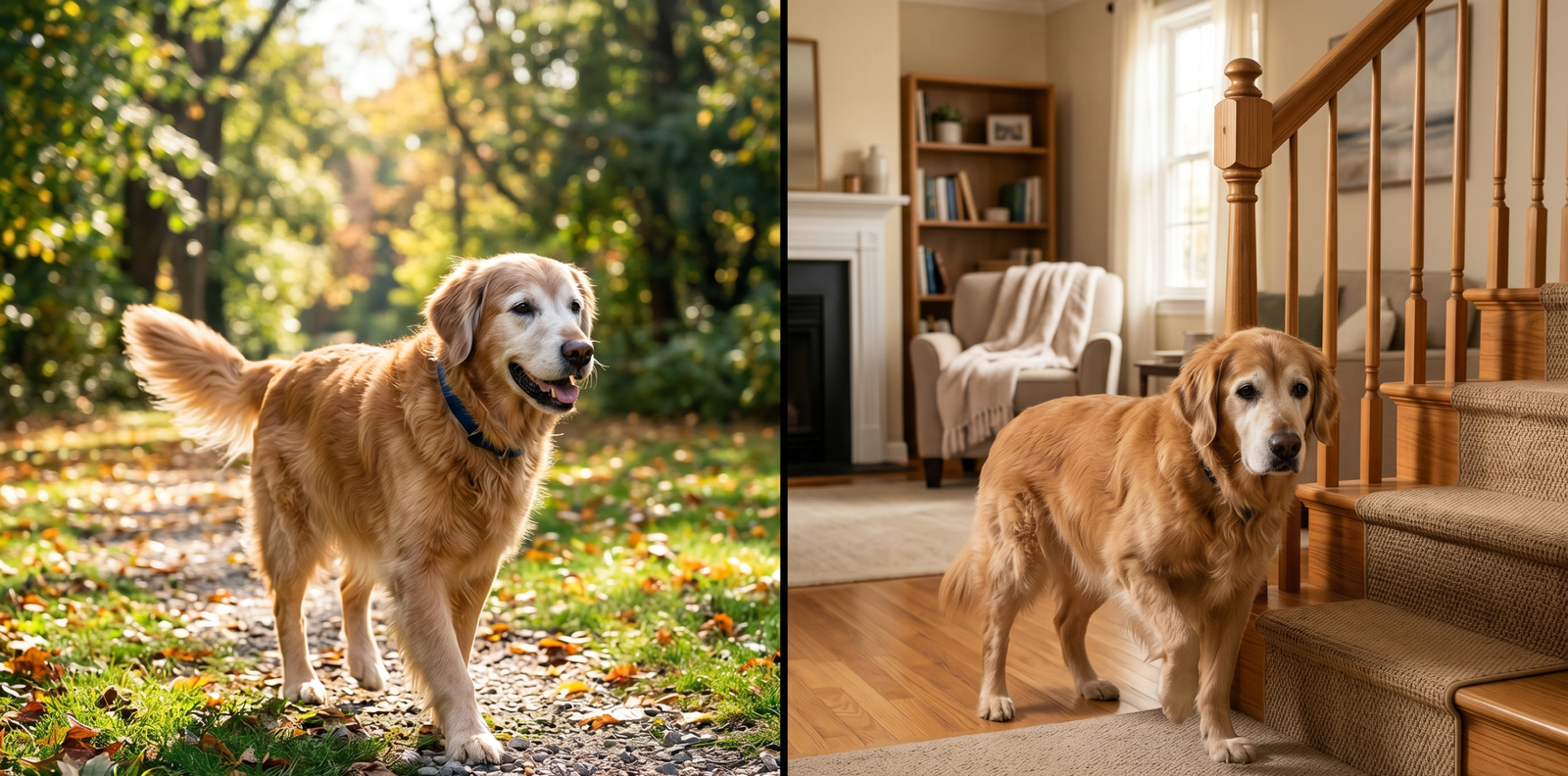
Quick Answer: How to Tell if an Older Dog Has Arthritis
Aging brings an even slowing down across all activities, while canine osteoarthritis produces distinct stiffness that improves after a dog warms up with gentle movement. Other clear arthritic indicators include limping, hesitation on stairs, difficulty jumping into vehicles, and touch sensitivity along the hips or lower spine. Dogs rarely whimper or cry from joint pain. Behavioral reluctance and postural shifts serve as the primary signs of active joint inflammation.
Key Takeaways for Caregivers
- Normal aging is gradual and consistent: An aging dog slows down steadily across months and years. Energy levels taper evenly throughout the day, and rising from rest takes a moment without visible physical struggle.
- Arthritis pain follows recognizable cycles: Joint stiffness peaks first thing in the morning or after prolonged rest, eases with gentle activity, and flares again following overexertion. Normal aging does not produce this warm-up pattern.
- Dogs rarely vocalize chronic joint discomfort: An older pet can experience significant joint soreness while remaining silent. Tail wagging and a healthy appetite continue even when joints ache.
- Up to 80% of dogs over 7 years old develop osteoarthritis: Degenerative joint disease is widespread in senior dogs, yet an estimated 40% remain undiagnosed because owners mistake mobility restrictions for routine aging.
- Physical orthopedic examinations confirm the diagnosis: A veterinarian palpates joint margins, detects fluid or crepitus, and evaluates weight-bearing posture to differentiate arthritis from general geriatric slowing.
Your senior dog takes longer to get up in the morning. He still greets you happily and clears his dinner bowl. Is he experiencing ordinary age-related changes, or is joint pain restricting his daily movement?
This distinction is essential for pet caregivers. Dogs with untreated osteoarthritis endure chronic discomfort without crying out or whimpering. Recognizing specific mobility patterns enables you to pursue veterinary relief early, preserving joint function and keeping your dog comfortable throughout his senior years.
Table of Contents
What Normal Aging Looks Like
Normal aging in dogs is a steady, progressive biological process that does not cause joint pain.
An aging dog experiences symmetrical changes over time. He sleeps longer hours, tires earlier on walks, and stands up with slightly less speed. His muzzle greys, his coat texture changes, and he may display moderate decreases in hearing acuity. When invited to play, he participates gladly, even if his sessions end sooner than in his youth.
A normally aging dog does not experience unpredictable good days and bad days in mobility. He does not wake up severely stiff and then loosen up as he walks around the kitchen. He does not favor one limb while walking, nor does cold or damp weather abruptly worsen his movement. The decline is steady, predictable, and symmetrical.
Standard physiological aging brings mild, symmetrical muscle loss, greying fur, slower sensory responses, lower resting calorie burn (as detailed in our guide on senior dog caloric requirements), and reduced aerobic endurance. It does not produce gait asymmetry, localized joint swelling, hesitation loading a specific leg, or morning stiffness that resolves after walking. Those four symptoms point to joint disease.
What Arthritis Looks and Feels Like
Canine osteoarthritis involves progressive cartilage breakdown within synovial joints. As protective cartilage thins, subchondral bone surfaces experience direct friction, triggering localized inflammation, osteophyte (bone spur) formation, and periarticular pain.
The hallmark indicator detailed in our review of signs your senior dog is in pain from arthritis is the rest-to-movement stiffness cycle. An arthritic dog hesitates before standing after a long rest, takes short, guarded steps for the first 10 to 20 minutes, and gradually loosens as synovial fluid warms and circulates. If the dog engages in prolonged exercise later that day, joint inflammation rebounds, causing pronounced soreness the next morning. Providing a true orthopedic bed for large senior dogs cushions vulnerable bony prominences and eases this initial morning stiffness.
Arthritic dogs also exhibit anatomical compensation. They avoid leaping into cars or onto furniture. They pause at staircases, shift their center of gravity away from affected limbs, lick repeatedly at carpal or tarsal joints, and pull back when their lower spine or hips are touched. When slick floors compromise stability, laying down dedicated non-slip indoor rugs for aging pets provides the secure traction needed to prevent guarding.
At What Age Do Dogs Get Arthritis?
Dogs can develop arthritis at any point in life, but clinical joint stiffness most commonly becomes noticeable between 7 and 10 years of age. Large and giant breeds frequently show radiographic and mobility changes much earlier, often by 5 to 6 years of age, whereas smaller toy breeds typically maintain sound joints until 9 or 10 years.
Body size and genetics play the most substantial role in determining when joint cartilage begins to deteriorate. Large breeds such as Labrador Retrievers, German Shepherds, and Golden Retrievers carry heavier body weights that place continuous mechanical stress on hip and stifle cartilage. In contrast, smaller dogs experience less cumulative joint loading over their lifetimes, delaying cartilage breakdown.
However, age is not the sole factor. According to the American College of Veterinary Surgeons, secondary osteoarthritis frequently develops in young dogs following physical trauma, such as a cranial cruciate ligament tear, or developmental conditions like elbow or hip dysplasia. In dogs with prior joint injuries, degenerative joint disease can begin quietly in early adulthood, surfacing as chronic stiffness years later.
Arthritis vs Normal Aging: Side-by-Side
Distinguishing true joint pathology from natural aging requires evaluating specific daily movements and postures. The comparison table below highlights how key behaviors differ between normal physical decline and painful osteoarthritis:
| Sign / Behavior | More Likely Arthritis (Pathology) | More Likely Normal Aging (Natural Decline) |
|---|---|---|
| Stiffness after rest | Struggles to rise; walks stiffly for 10 to 20 minutes until joints warm up. | Rises slightly more slowly, but gait is symmetric and fluid immediately. |
| Limping | Favors one limb consistently or bobs head when stepping on a sore joint. | Never normal; limping always signals pain, injury, or focal disease. |
| Reluctance on stairs or jumping | Hesitates, whines, bunches hind legs together like a bunny, or refuses stairs entirely. | Navigates steps at a deliberate, measured pace without guarding or hesitation. |
| Licking joints | Obsessively licks or chews at wrists, carpi, or hocks to soothe deep joint ache. | Grooms normally; does not focus repetitive attention on specific joints. |
| Sleeping more | Sleeps to avoid movement pain; circles repeatedly or groans trying to find comfort. | Enjoys deeper naps due to lower energy, but settles into sleep comfortably. |
| Greying muzzle | No correlation with joint inflammation. | Purely cosmetic loss of pigment in facial hair follicles. |
| Slower walks | Lags behind, sits down mid-walk, or shows severe stiffness the next morning. | Trots with lower top speed and sniffs more, but remains eager throughout the walk. |
| Irritability when touched | Flinty growling, pulling away, or snapping when hips, back, or paws are handled. | Calm and receptive to physical affection, though may startle if vision or hearing is diminished. |
Arthritis in an Old Dog’s Back Legs
When osteoarthritis strikes the hips, knees, or lumbosacral spine, weakness in the rear limbs becomes the dominant symptom. Older dogs often sway from side to side, cross their hind feet while walking, or struggle to get their rear paws underneath them on hardwood floors. If your dog knuckles their back toes or slips frequently, read our focused clinical guide on arthritis in old dogs back legs for supportive lifting harnesses, traction tips, and home physical therapy exercises.
The 10-Sign Checklist to Use at Home
Observe your dog over three to four consecutive days before drawing conclusions. A single isolated slip or quiet afternoon is not definitive. Consistent physical patterns across multiple days provide reliable evidence.
| # | Sign to Observe | Specific Question to Answer | Score (Y/N) |
|---|---|---|---|
| 1 | Morning stiffness | Does he take 10 to 20 minutes of movement before walking normally after waking? | [ ] Yes [ ] No |
| 2 | Stair hesitation | Does he pause, measure his footing, or refuse stairs he used to climb without hesitation? | [ ] Yes [ ] No |
| 3 | Jump avoidance | Has he stopped getting onto sofas, beds, or vehicle boots that he previously mounted easily? | [ ] Yes [ ] No |
| 4 | Limb preference | Does he consistently shift weight off one particular leg when standing or sitting? | [ ] Yes [ ] No |
| 5 | Joint licking | Does he repeatedly lick or nibble at the same carpus (wrist), tarsus (hock), elbow, or knee? | [ ] Yes [ ] No |
| 6 | Touch response | Does he flinch, turn his head, move away, or guard when you handle his hips, elbows, or stifles? | [ ] Yes [ ] No |
| 7 | Post-exercise worsening | Is he noticeably stiffer or slower to rise the morning after an extended walk or play session? | [ ] Yes [ ] No |
| 8 | Weather sensitivity | Does he show more reluctance to move on damp, humid, or chilly mornings specifically? | [ ] Yes [ ] No |
| 9 | Sitting posture shift | Does he sit in a splayed or lazy posture with one hind leg kicked out to avoid knee or hip flexion? | [ ] Yes [ ] No |
| 10 | Muscle asymmetry | Do his thigh or shoulder muscles appear noticeably thinner or less defined on one side? | [ ] Yes [ ] No |
- 0 to 2 “Yes” answers: Mobility changes reflect normal physiological aging. Continue providing balanced nutrition, moderate daily walks, and comfortable joint support.
- 3 to 4 “Yes” answers: Early joint inflammation is likely present. Schedule a non-urgent veterinary exam to assess range of motion and consider early joint support.
- 5 or more “Yes” answers: Active osteoarthritis is the probable diagnosis. Bring this completed checklist and brief video clips to your veterinary appointment for diagnostic staging.
When and Why to See the Vet
If your checklist indicates 3 or more affirmative answers, arrange a veterinary evaluation. Waiting until a dog limps noticeably means postponing intervention until cartilage degradation has progressed into moderate or advanced stages.
Documenting exact home behaviors provides your veterinary team with invaluable diagnostic context. Explaining that your dog pauses at the foot of stairs for two minutes each morning before descending gives clearer clinical insight than reporting general sluggishness.
Never administer human over-the-counter painkillers to a dog while awaiting a veterinary appointment. Acetaminophen (paracetamol) and ibuprofen cause life-threatening liver toxicity, kidney failure, and acute gastrointestinal ulceration in canines. Aspirin damages canine gastric mucosa and prevents your veterinarian from prescribing effective veterinary-licensed anti-inflammatory therapies due to drug clearance washout requirements.
Frequently Asked Questions
Can a dog have both arthritis and normal aging at the same time? +
Yes, and most senior dogs experience both simultaneously. Normal aging reduces baseline metabolic stamina and lean muscle tone, while osteoarthritis contributes joint pain and mobility hesitation. Treating joint inflammation often helps a senior dog display renewed enthusiasm and mobility once the burden of chronic discomfort is lifted.
My dog still plays fetch. Can he still have arthritis? +
Yes. Dogs frequently push through joint discomfort during high-arousal games like fetch. Endorphins and adrenaline temporarily blunt pain perception during play. The consequence surfaces hours later or the following morning, manifesting as prolonged resting, stiffness upon rising, or reluctance to walk.
What does the veterinarian check to diagnose arthritis? +
A veterinarian begins with a physical orthopedic evaluation, assessing gait, weight distribution, and limb symmetry. They palpate each joint individually to check for heat, joint effusion (fluid swelling), periarticular thickening, crepitus (grating sensations), and pain responses through flexion and extension. Orthopedic radiographs (X-rays) provide definitive imaging of osteophytes and joint narrowing, while baseline blood panels ensure safe organ function prior to prescribing targeted medications.
Can canine arthritis be cured or is it manageable? +
Osteoarthritis is a chronic, progressive condition that cannot be reversed because lost cartilage does not regenerate. However, pain and localized inflammation are manageable through multimodal veterinary care, including prescription NSAIDs, monoclonal antibodies (such as bedinvetmab), therapeutic joint supplements, controlled physical therapy, and home floor adaptations.
At what age do dogs get arthritis? +
Most dogs develop noticeable clinical signs of arthritis between 7 and 10 years of age. Large and giant breeds frequently show joint stiffness earlier, around 5 or 6 years, while smaller dogs tend to maintain healthy joints longer. Dogs with prior ligament injuries or hip dysplasia can develop secondary osteoarthritis much earlier in life.
How can I tell if my dog has arthritis or is just old? +
Normal aging reduces overall energy and endurance, but the dog remains eager to walk and moves symmetrically. Arthritis causes focal pain: stiffness after resting that warms up with movement, limping, reluctance on stairs or jumping, obsessive joint licking, and irritability when handled. If your dog avoids activities they used to love, pain rather than age is usually responsible.
Summary: Evidence-Based Care Protocol
Distinguishing arthritis from normal aging protects your senior dog from unmanaged chronic pain. Normal aging proceeds evenly, while arthritis presents specific behavioral markers: morning stiffness that improves with gentle movement, weather sensitivity, hesitation on stairs, and asymmetrical weight bearing.
When your dog displays 3 or more signs from the home checklist, arrange a veterinary evaluation. Identifying degenerative joint disease early allows for comprehensive pain management before joint structures suffer severe damage.
For actionable home modifications and veterinary treatment protocols, explore our complete guide on how to help a senior dog with arthritis pain at home.
Sources and Authoritative References
The clinical criteria, age onset ranges, and mobility evaluations in this guide are grounded in veterinary literature and specialty orthopedic guidelines:
- American College of Veterinary Surgeons (ACVS): Osteoarthritis in Dogs. Clinical review of primary vs secondary osteoarthritis pathophysiology and joint injury progression.
- Merck Veterinary Manual: Arthritis in Dogs. Diagnostic criteria, physical examination findings, and medical staging for canine degenerative joint disease.
- American Animal Hospital Association (AAHA): Pain Management Guidelines for Dogs and Cats. Evidence-based protocols on multimodal pain control and assessing chronic osteoarthritis pain in companion animals.
Veterinary Medical Notice: This article provides educational guidance for pet caregivers and is not a substitute for clinical veterinary diagnosis, laboratory staging, or personalized medical care. If your pet shows acute distress, limb collapse, or severe pain, consult your veterinarian immediately.

