
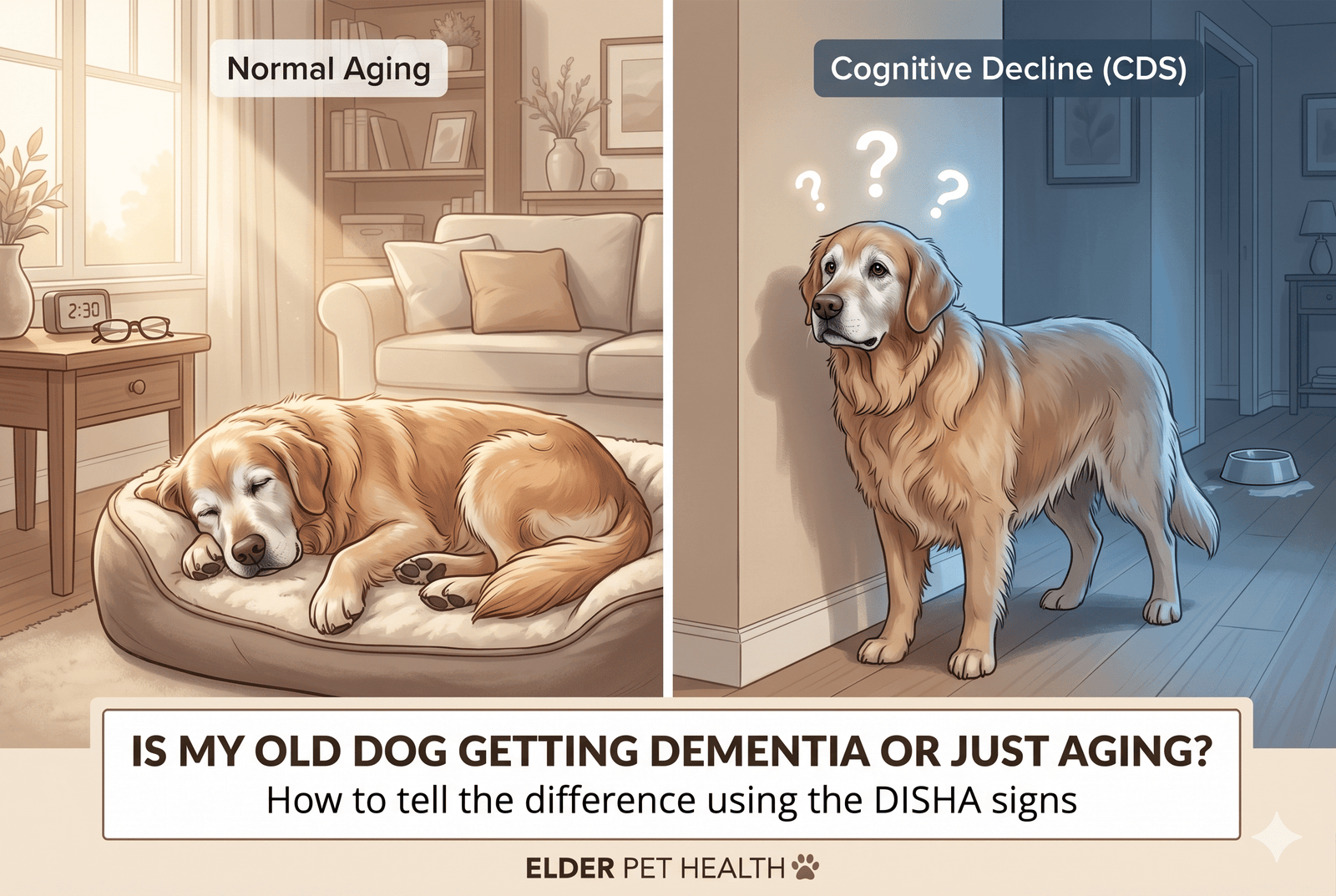
Quick Answer: Senior Dog Dementia vs. Normal Aging
Normal aging causes mild physical slowing and sleep changes, whereas Canine Cognitive Dysfunction involves progressive disorientation, wandering aimlessly, getting stuck in corners, changes in house-training, and disrupted day-night cycles. If memory lapses and social withdrawal persist or worsen, veterinary assessment can distinguish cognitive decline from sensory loss or chronic pain.
Key Takeaways for Caregivers
- Canine Cognitive Dysfunction Syndrome (CDS) is the dog equivalent of Alzheimer’s disease. The brain develops plaques and structural changes. It is not just “getting slow.” It is a neurological condition.
- 28% of dogs aged 11-14 show CDS signs. By 16, this rises to over 60%. It is extremely common and extremely underdiagnosed. Most vets only find out about symptoms when they ask owners directly.
- Normal aging does not cause disorientation, confusion, or personality changes. A normally aging dog is slower and less energetic. A dog with CDS gets lost in familiar rooms, forgets learned behaviours, and seems genuinely confused.
- CDS is a diagnosis of exclusion. Before diagnosing dementia, vets rule out pain, hypothyroidism, vision and hearing loss, hypertension, brain tumours, and other conditions that can cause similar signs. A full workup matters.
Your 12-year-old dog has started standing in the corner of the room, staring at the wall. He sometimes seems to forget where his water bowl is. He woke you up at 2am two nights ago barking at nothing.
You wonder if he is losing his mind, or if this is just what getting old looks like. Owners often call it senility, and the veterinary name for it is canine cognitive dysfunction, or CCD. The answer matters because canine cognitive dysfunction is a real, diagnosable condition with management options , and it is different from normal aging in ways you can actually observe at home.
Table of Contents
Can Dogs Get Dementia?
Yes, dogs can develop dementia, clinically diagnosed by veterinarians as Canine Cognitive Dysfunction (CCD) or Cognitive Dysfunction Syndrome (CDS). This progressive neurodegenerative disorder shares striking biological similarities with human Alzheimer’s disease, including cortical brain atrophy, loss of functional neurons, and the toxic accumulation of beta-amyloid protein plaques.
Cognitive decline is remarkably prevalent among aging canines, though it frequently goes unrecognized in its early stages. Peer-reviewed epidemiological studies published in veterinary neurology literature indicate that approximately 28 percent of dogs aged 11 to 12 years and nearly 68 percent of dogs aged 15 to 16 years exhibit at least one consistent behavioral symptom of cognitive impairment. While normal aging slows physical speed, canine dementia fundamentally alters spatial orientation, family social interactions, and circadian sleep rhythms.
At What Age Do Dogs Get Dementia?
Most dogs diagnosed with canine cognitive dysfunction begin showing initial behavioral changes between 10 and 12 years of age. While clinical dementia is rare in young or early senior dogs, subtle cognitive shifts can begin as early as 9 years of age in large breeds with shorter average life expectancies.
Large scale studies from the Dog Aging Project demonstrate that the risk of developing cognitive dysfunction rises exponentially with each additional year of life past senior milestones. Small breeds that routinely live into their mid-teens often maintain sharp cognitive faculties until 12 or 13, whereas giant breeds may experience cognitive decline alongside severe joint deterioration around 8 or 9 years. Recognizing mild signs early allows caregivers to implement supportive neuroprotective therapies before severe disorientation takes hold.
Dementia Signs Checklist (DISHA)
Veterinarians and veterinary behaviorists evaluate canine cognitive dysfunction using the validated DISHA framework. If you suspect your older dog is becoming senile, this clinical checklist outlines how cognitive decline manifests across core behavioral domains:
| Letter | What It Means | Example Behaviors to Watch For |
|---|---|---|
| D | Disorientation | Getting trapped behind open doors, standing on the hinge side, staring blankly into empty corners or walls, and getting lost in familiar household rooms. |
| I | Interaction Changes | Withdrawing from family members, failing to greet caregivers at the door, demanding constant clingy attention, or showing uncharacteristic irritability when approached. |
| S | Sleep-Wake Cycles | Sleeping heavily throughout the daytime, waking frequently at 2:00 AM or 3:00 AM, pacing hall corridors at night, and whining or barking without apparent trigger. |
| H | House Soiling | Urinating or defecating indoors shortly after being outside, failing to signal the need to go out at the door, and losing awareness of elimination in resting areas. |
| A | Activity Changes | Repetitive aimless wandering, pacing fixed circular patterns across the room, diminished curiosity in toys or walks, or rapid fluctuations between lethargy and agitation. |
| A | Anxiety | New fear of familiar household noises, acute separation anxiety when caregivers leave the room, trembling, vocalizing in new environments, and shadows startle responses. |
Nighttime Pacing and Sundowning
Sundowning is a distressing manifestation of canine cognitive dysfunction where confusion, vocalization, and restless wandering intensify significantly as daylight fades. As natural lighting dims, sensory perception weakens, amplifying cognitive disorientation and triggering panic pacing across slick hardwood and tile floors. Laying down non-slip indoor rugs and runners along your dog’s nightly walking paths prevents painful slips, provides joint stability, and muffles clicking toenails so the household can rest.
What Causes Dementia in Dogs?
The short version is that the aging brain changes physically, and those changes reduce cognitive function in ways that show up as behaviour.
Canine cognitive dysfunction, often shortened to CCD, is frequently described as the canine equivalent of Alzheimer’s disease in people. That comparison is not just a convenient analogy. Dogs with dementia accumulate abnormal protein deposits in the brain, including beta-amyloid plaques, which are one of the hallmarks of Alzheimer’s disease in humans.
Alongside those deposits, blood flow to the brain reduces, oxidative damage builds up over years, and the neurotransmitters that support memory and learning decline. The result is a gradual loss of cognitive function rather than a sudden failure, which is exactly why owners struggle to pinpoint when it started.
Age is the main risk factor
Prevalence climbs steeply with age. A meaningful proportion of dogs over 11 show at least one sign, and the figure rises sharply again past 15.
It is under-diagnosed
Most cases are never reported to a vet, because owners interpret the changes as ordinary aging and do not think to mention them.
Other conditions mimic it
Pain, hearing loss, vision loss, kidney disease and hyperthyroidism can all produce similar behaviour. This is why a vet exam matters before assuming dementia.
How Vets Diagnose and Treat Dog Dementia
Because there is no single laboratory blood marker for canine cognitive dysfunction, diagnosis is primarily a process of medical exclusion. Veterinarians must systematically rule out treatable physical conditions that mimic dementia signs, including chronic osteoarthritis pain, sensory deficits like cataracts or nuclear sclerosis, middle ear deafness, urinary tract infections, and intracranial tumors.
To establish a clear clinical baseline and exclude metabolic encephalopathy, your veterinarian will recommend full senior pet blood work, including a complete blood count, biochemistry panel, thyroid testing, and urinalysis. Staging kidney function and liver enzymes ensures that symptoms like house soiling or lethargy are not stemming from metabolic organ failure.
While cognitive dysfunction cannot be cured, modern veterinary medicine offers multimodal interventions to slow progression and enhance quality of life:
- Nutritional neuroprotection: Prescription diets enriched with medium-chain triglycerides (MCTs), antioxidants, and omega-3 fatty acids provide alternative ketone energy for aging neurons and reduce oxidative damage.
- Cognitive enrichment: Gentle sensory games, food puzzle toys, and consistent daytime interaction stimulate neural pathways and support neuroplasticity.
- Predictable daily routines: Keeping feeding, walking, and bedtime schedules strictly uniform reduces anxiety and grounds a disoriented dog’s circadian expectations.
- Targeted prescription therapies: Your vet may evaluate veterinary prescription options such as selegiline, an MAO-B inhibitor that prolongs dopamine activity in the brain, or specific anxiolytics for nighttime agitation.
- Supportive nutraceuticals: Veterinary supplements containing S-adenosylmethionine (SAMe), phosphatidylserine, and apoaequorin support cellular membrane fluidity and brain antioxidant reserves.
What Normal Aging Looks Like Instead
A normally aging dog reduces in energy and stamina. He naps more, plays less, tires on longer walks. His senses dull slightly. He may not hear you call from another room as well as he did at 5. His coat changes texture or thins. He may have grey on his muzzle and face.
What a normally aging dog does not do is get confused in his own home. He does not forget that the garden is where he toilets. He does not stare at walls for minutes at a time. He does not bark at nothing in the middle of the night. He does not fail to recognise family members.
Home Observation Checklist: 14-Day Symptom Tracker
Track these 8 clinical signs over a two-week period. Note frequency and film distinct episodes to help your veterinary team formulate a staging plan:
What You Can Do to Help
There is no cure for CDS. But there are meaningful management options that can slow progression and reduce the distress your dog experiences.
Selegiline (Anipryl)
The only FDA-approved medication for canine cognitive dysfunction. Works on dopamine pathways in the brain. Helps some dogs significantly, with modest results in others.
Omega-3 fatty acids
EPA and DHA support brain cell membrane health. Some evidence shows slower cognitive decline in dogs on therapeutic doses. Also beneficial for joint health in older dogs.
Night lights
Dogs with CDS disorientation use visual cues heavily. Night lights in key rooms reduce night-time confusion and the distress vocalisation that disrupts sleep for everyone.
Strict routine
Feeding, walking, and sleeping at the same times every day reduces anxiety in a dog whose brain processes new information poorly. Predictability is a genuine comfort.
Frequently Asked Questions
At what age should I start watching for dementia signs?+
Begin active observation from age 9 to 10. Signs can appear earlier in some breeds, particularly those with genetic predispositions. Using the DISHA checklist annually from age 9 gives you a personal baseline. Changes that appear gradual are easier to track when you have a record of what was normal a year ago compared to what you are seeing now.
Can anxiety or pain cause the same signs as CDS?+
Yes, and this is exactly why CDS is a diagnosis of exclusion. Chronic pain from arthritis can cause night-time restlessness, reduced interaction, and changes in movement. Anxiety can cause repetitive behaviours. Hearing loss can make a dog appear disoriented when he is simply not hearing cues. Your vet needs to systematically rule these out before concluding that the signs are CDS rather than another treatable condition.
How fast does canine cognitive dysfunction progress?+
It is a progressive condition, meaning it gets worse over time rather than improving. The rate varies considerably between individual dogs. Some dogs show mild signs for years before significant decline. Others deteriorate more quickly. Early intervention with medications, supplements, and environmental adaptations is associated with slower progression in most dogs.
Can dogs get dementia? +
Yes. Dogs develop a neurodegenerative condition known as Canine Cognitive Dysfunction (CCD), which shares strong biological and behavioral similarities with human Alzheimer’s disease. Clinical signs include disorientation, sleep disturbances, house soiling, and interaction changes.
At what age do dogs get dementia? +
Dementia symptoms typically appear between 10 and 12 years of age, though large breeds may show earlier signs around 9, and small breeds might not manifest symptoms until 13 or 14. The incidence of cognitive dysfunction increases significantly each year into late geriatric life.
Do dogs with dementia suffer? +
Dogs do not experience emotional existential dread about memory loss, but they can experience acute anxiety, panic, and distress when disoriented or separated from their caregivers. Working with your veterinarian to manage nighttime anxiety and establish environmental stability preserves comfort and prevents suffering.
How long can a dog live with dementia? +
With proactive veterinary support and supportive home care, many dogs live comfortably for one to three years or longer following diagnosis. Progression varies widely depending on overall organ health, mobility, and how early interventions are initiated. Consult your veterinarian to track quality of life milestones.
Clinical Summary: Managing Geriatric Cognitive Decline
If your senior dog shows confusion in familiar rooms, disruptive midnight restlessness, bathroom accidents, or flattened social engagement, these changes reflect neurodegenerative processes rather than unavoidable natural aging.
Document specific behaviors using the DISHA framework, record brief video clips of episodes, and consult your veterinarian for an objective neurological and metabolic evaluation.
Sources and Authoritative References
The diagnostic criteria, prevalence rates, and clinical management strategies in this guide are grounded in published veterinary neurology literature and animal welfare guidelines:
- PubMed (Salvin et al., Molecular Neurobiology / Vet J): The Canine Cognitive Dysfunction Rating Scale (CCDR). Clinical diagnostic tool and prevalence data for cognitive decline in companion canines.
- PubMed (Dog Aging Project, Scientific Reports): Associations Between Physical Activity, Health, and Cognitive Dysfunction in Companion Dogs. Large cohort analysis of age onset and lifestyle factors.
- PubMed (Neilson et al., JAVMA): Prevalence of Behavioral Changes in Aging Dogs. Foundational study on frequency of DISHA cognitive signs in older canines.
- American Animal Hospital Association (AAHA): Senior Care Guidelines for Dogs and Cats. Evidence-based protocols on diagnostic screening, routine stabilization, and cognitive management in senior pets.
Veterinary Medical Notice: This article provides educational information for pet caregivers and is not a substitute for clinical veterinary diagnosis, laboratory staging, or personalized medical care. If your pet shows acute distress, pain, or severe lethargy, consult your veterinarian immediately.

